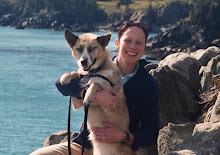
The first Saturday of the month is temperate but gray. Ari and I drive into town, first to the local farmers’ market and then my college campus for a woodland walk. We’re already known at both places. I suppose that Greg and I stand out a bit in this community, where the median age is well over forty and our few contemporaries already have multiple children. Ari stands out too, but more so because she is a real attention hound. At the market, she mugs for the farmers, spinning on the length of her leash and cocking her head as they coo over her eyes and soft fur. One farmer, who seems particularly taken with the pup, offers to sit with her while I finish my marketing. For a moment I worry we will be inconveniencing her. However, her expression tells me this is as much favor to her as it is to me.
When I return a few minutes later, I find Ari sampling the farmer’s wares. A masticated carrot and radish lie in pieces about the farmer’s lawn chair, and a very contented puppy rests nearby, an early snowpea clutched between her paws.
“She likes them,” says the farmer proudly, who then looks at the half-chewed vegetable smorgasbord strewn about. “The peas, I mean.”
“She has good taste. They’re my favorite, too.”
This compliment earns us a complementary bag of peas for the road, which the pup and I share as soon as we return to the car. The pods are small and slender—the perfect size for both human and dog mouths. I dole them out for us as we drive up the hill towards campus—one for her, one for me. Ari grows impatient with this system, gobbling up her share quickly and trying to bury her snout in the bag. I don’t know what these taste like to her, but to me they are pure summer: verdant, sweet, and light incarnate. Our weather may be lagging behind, but the vegetables know what’s what.
Once we arrive at school, I stuff the remaining peapods in my pocket and park at a gravel lot near the athletic fields and away from any traffic. Leash-free, Ari bounds from the car and cavorts across the soccer field, spinning figure-eights and other loose geometry on the shaggy field. She stops every few minutes to make sure I’m watching—partly for security, mostly because she wants an audience. She knows I am more than happy to oblige. After making eye contact, she intensifies her routine for both our amusement.
The sky hangs low and thick today, acquiescing only to the occasional rush of sea air from the nearby coast. This cloud-cover makes the light flat, compressing hues and contrasts until they become nearly indistinguishable. The pup couldn’t care less, and she continues her leaping and spinning around the field. But it does mean she’s late to notice a swallow-like bird—the same color as our leaden sky—swoop down out of a large spruce tree to join in the fun. Fearlessly, the bird dives down within striking distance of Ari, then pulls up just out of reach. When Ari stops, puzzled, the bird circles back, completing first one, and then another flyby just above the pup’s head. Ari’s surprise soon turns into eagerness. Is this a game?, she seems to ask.
Deciding that the next few minutes will be more fun if the answer is yes, she rises on her hind legs and paws at the air. The bird drops down just out of reach, then quickly rises in the air. As it does, it looks back at the pup, who is trying unsuccessfully to levitate. If birds could laugh, I’d swear this one was snickering. Forget about the timidity we assign to much of the avian world—this is one brazen little bird.
Later, we identify our new friend as a young female purple martin (Progne subis), just back from a winter in the Amazon River Basin and ready to start a family of her own. The largest of all swallows, the purple martin is the Blue Angel of the bird world, swooping its way through unbelievable stunts for food and water. In fact, the martin does all of its eating and drinking in flight. Not surprisingly, it has earned the reputation of being one of the most acrobatic of all swallows—and the most playful. Martins seem to find particular pleasure in the sheer exuberance of aerial acrobatics and puckish behavior. But they’re far from unique in that area. Many species of birds, in fact, seem to exercise and play tricks for no reason other than the sheer enjoyment of it all.
I see this impulse in our martin. She dips again, buzzing just past the upturned snout of the pup. Ari leaps higher; the martin zooms in, then executes a snapping roll. As she does, the pup bucks in the air, kicking out her hind feet like a donkey. The bird keeps its altitude low, cartwheeling through turnabouts and slips, then ascending high into the air, only to drop back down again. Ari tries to do the same from the ground, though she’s no match for the aerial prowess of this flying ace. Still, she gives it her best, staying close to the martin and following her about the field. She wants desperately to catch up, but the martin stays just out of reach.
It seems like only yesterday I was chasing Ari around our kitchen table, preparing for our first walk. Now, however, Ari is old enough to realize what I knew then: namely, it’s no fun to play tag when you’re always it. Her exuberance for the martin begins to fade. When it seems as if the pup has tired of the game entirely, the bird swoops in again—even closer this time—and spins mad, low-lying circles around the field, chattering back at the pup as she does. The increased boldness of the bird incites Ari, and she begins her chase again. Eventually though, the pup looks frustrated. She’s being taunted—and she knows it. This martin isn’t about to let her catch up, let alone get the upper hand. Ari trots back to me and sits on her haunches. Game over, she seems to insist. The martin gives another few fly-bys, just in case. But the pup is firm: she’s not having fun anymore, and she doesn’t like being a plaything.
Friday, June 1, 2007

Friday, May 25, 2007
Forest Booty

By the end of May, we are two months into our naturalism project. I’m still no expert on canine values, but I feel prepared to draft a preliminary caninaturalist manifesto based on our time in the woods.
The finished policy reads as follows:
- Never go around anything you can jump over or wiggle under.
- Noxious materials exist to be felt and experienced first hand.
- To that end, any surface becomes positively embellished when caked in ooze.
- All creatures exist solely for our amusement.
- Everything—and I mean everything—is edible.
I feel confident in asserting these conventions because they so clearly dictate Ari’s behavior in the woods. She has come to find great delight in wiggling under logs and splashing through puddles; any puddle playing home to another animal or two is an absolute windfall for the pup. For my part, I’m doing better with the wiggling and squelching—and I’m even mostly amused by both, provided a hot shower awaits shortly after.
Even still, the last of these canine rules has me concerned. As the snow disappears from even the shadowiest places, two seasons of potentially edible treasures have emerged. Each walk, Ari returns from a brief foray into the brush with a new example of what lies just beyond the trail. A few days ago, it was an entire piece of breakfast pizza: an enormous, congealed palimpsest of dough, eggs, cheese, and sausage left by a winter hunter. It’s a useful reminder for me that this land is far from pure wilderness. For Ari, it’s pure heaven.
Once free from the underbrush, she side-stepped wildly with this forest booty—which was considerably bigger than her head. She walked awkwardly, trying to balance her small frame against the huge slice, and then tripped over the dragging tip of the pizza. As she did, her little back legs splayed out, causing her to roll to a stop only after she was well out of reach of the pizza. I snatched it up and tossed it, Frisbee like, into the woods, then promptly attached the puppy to her leash so that she couldn’t go off in pursuit.
It took hours for her to forgive me. And in that time, I think she might have been plotting new tactics for maintaining her forest booty. If so, the strategizing seems to have worked.
On our walk yesterday, Ari remained out of sight longer than normal. I began to worry, calling her name and fearing that she had either gotten lost or into trouble. Luckily, she is a good student in school and mostly understands recall. At the sound of her name, she bounded out of the woods, dragging along with her an entire leg of a white-tailed deer (Odocoileus virginianus). This find—which spanned from thigh bone to hoof—measured nearly three feet long and was massive by puppy standards. It, unfortunately, is not a topic we have covered in class.
Even still, Ari beamed with her find. “Look!” she seemed to say, “Look at this!! We can eat off of this thing for a whole week!!!”
I wanted to appreciate her enthusiasm and the thoughtfulness behind her desire to share. Still, I found it impossible to overcome my very human response to this festering limb: yuck. It may not have been a medieval plague victim on a corpse cart, but this leg certainly headlines my list of undesirable dinner options. I pull rank and disobey my primary directive: today, I get to dictate our time in the woods. And that time will most certainly not include a rotten deer leg.
Ari seemed both perplexed and offended when I demanded that she let it go. As Don Hanson explained to me during our first meeting, dogs are opportunists. If they see food, they need to eat it. Now. Leaving behind as big a find as this isn’t just poor form, it could be tantamount to suicide under extreme conditions. Ari’s hardwiring isn’t about to let that happen. I know this. But my disdain for decomposing deer parts isn’t about to let her bring it with us. So I resort to the theory that socialization trumps all else. I do my best to look disapproving. This is not all that difficult, since the deer leg looks like another prop from that zombie movie, and I’m more than leery of getting anywhere near it.
Ari hesitates slightly when she sees the frown on my face—hasn’t she just brought a delightful treat for us to share? She raises an eyebrow and looks hurt, almost. I refuse to be wooed by the puzzled expression and fetching blue eyes. “No, Ari.” I say firmly. “No.” As I repeat myself, I move slightly towards her, forgetting her mastery of my body language. The combination of the word “No” plus my forward movement has already resulted in confiscated breakfast pizza; Ari isn’t about to make the same mistake twice. As I walk towards her, she bolts, trailing the deer leg awkwardly behind her. She doesn’t go far, but she creates enough distance between us to ensure I’m not going to rob her of her deer leg. I stop and sigh. As I do, she stops as well, eyeing me over the enormous leg, which still hangs comically from both sides of her jaw. I take another step forward, but she can read my expression and knows that I’m still not about to revel in this ghastly treasure. She bolts again.
I am growing frustrated and yet I persist, knowing perfectly well that I will get the same result. I want her to drop this deer leg—both because it is disgusting and because I am under the mistaken assumption that my dog should know to obey me. Ari doesn’t accept either of these premises, however. And so, on and on we go until, finally, the brittle joints of the deer leg give way and it crumbles into three separate parts. As it does, we both stare at the leg, wondering what will happen next. In a tactical error, Ari reaches for the hoof, which now lies detached from the rest of the leg. In spite of myself, I feel smugly delighted: by my standards, this is the least offensive part of the leg; by dog standards, it’s undoubtedly the least useful—or pleasurable. Emboldened by what I take to be my small victory, I stand in front of the remaining leg, guarding it as my own. I don’t know why I do this; it’s certainly not a conscious decision. And yet somehow—perhaps through my own instincts—I determine that this is the appropriate response for my aims. Ari does, too. Sensing that I have laid claim, she abandons her attempts and, instead, makes her way towards the car, pretending she is satisfied with the hoof. One hundred yards later, I see it resting unceremoniously on the trail, forgotten by the puppy.
I will take this small victory. And with it, I will a sixth principle to my caninaturalist manifesto: all is fair in dog and war.
Thursday, May 10, 2007
Mud, Glorious Mud!

I’ve been thinking a lot this month about what it really means to be a canine naturalist. I cannot literally perceive the world as a dog would, so I must rely, instead, on preferences. When Ari finds something interesting, I need to stop and investigate it too. When she is repelled by something (which, admittedly, happens very rarely), my job is to determine why. An approximation of these value judgments is, I think, the closest I can get to seeing the natural world through a dog’s eyes. But even in this mitigated form, my project is a challenge. I’m still not sure I understand the rules of attraction for Ari. And try as I might, I cannot make myself embrace the idea of burying my nose in manure, nor can I relish a good roll on thawing muck.What it really comes down to, I think, is a divergence in natural values. Whether or not they are instinctual or learned, canines and humans clearly possess them. Greg’s and mine find their antecedent in classic western hierarchies, beginning with Aristotle’s academic classifications and continuing into contemporary cultural hierarchies.
Contemporary ethno-biologists now theorize that dogs create values in similar ways—at least insofar as achieving pleasure is concerned. As far as they know, this is not based on any sort of philosophical principle, but rather, something much closer to hedonism: if it feels good, do it; if it feels really good, do it some more. The question for me then, is this: why do some things provide great pleasure for Ari and not for me?
May is a good month to ask this question: at no time will Ari and I be so divided in our sense of what makes for naturalized recreation. This month is the height of mud season in New England: several weeks of rapid thaw that turns the entire landscape into brown ooze and makes simple tasks like walking to the mailbox a harrowing adventure. It’s no fun—at least for humans.
As for the dogs in the area, this time of year is just about perfect. My pup is no exception. Born and reared in the frozen landscape of winter, Ari has had no experience with wet, other than her water bowl and the much-feared hose at the shelter. Now, however, liquid is everywhere—and she can’t get enough.
On our first long walk of the month, the pup stops at a large puddle and cocks her head quizzically. This was a snowbank a few weeks ago, and she looks as if she’s not sure what to make of the transformation. Deciding it requires further investigation, she puts a tentative paw into the water. Unlike ice, it neither supports her weight nor cracks from the pressure. Instead, it yields, engulfing her paw until it hits the soft bottom below. This confuses her. She tries again, more cautiously this time. After a few tentative pokes, she begins to splash, pawing at both her reflection and whatever lies underneath the surface. As she does, she churns up decayed matter and sediment. She wades in a few more steps, eventually letting the water lap at her knees as she puts her snout into the puddle itself. She surfaces, clearing her airways in a hearty snort of slime, and smiles proudly. This is going to be great fun, she seems to say.
As the weeks progress, Ari becomes even more daring around liquid—she zigzags across the trail, seeking out puddles of all ilk. She stops at each one, pouncing madly upon it and grinning as the force of her paws is enough to send up a plume of water and sediment. By the middle of the month, my timid puppy has become a veritable daredevil when it comes to water and mud. No longer content with the tame little depressions on our path, she leaps from the trail, tripping over her hind legs and belly-flopping into any liquid body she can find. When she returns, she brings decaying leaves, soil, and all sorts of microbes embedded in her drenched coat.
Ari’s fur usually smells of cut hay—a little bit sweet, a little bit dusty. Now, however, she moves about in a cloud of noxious sulfur, which soon insinuates itself into my car, our carpets—even my clothes. By the middle of the month, I find myself yearning for the mere smell of decomposing leaves after Ari discovers a rotting snake carcass and insists upon rolling on it every time we get near. She moans with pleasure as she wriggles across the carcass and prances for the rest of the walk, clearly thrilled with the find. My moan of disgust does little to dissuade her. If anything, she looks at me with disappointment and maybe even a little pity. Don’t humans understand how great rotting snakes smell? No. Really no. And no some more.
Still, the thawing landscape has become an oasis for my otherwise-overwhelmed pup. This is particularly true in areas where puddles and ponds are exposed. While there, Ari loses sight of her anxiety and reluctance; in their place, I see pure carpe diem. Luckily for her, these mysterious pools are appearing everywhere. Nearly every step of our path is now flanked by a discrete body of water, and it appears as if our forest has assumed a distinctly Venetian quality. In the midst of it all, a gondola of a dog steers her way from pool to pool, her tail making a most peculiar ricciolo.
We adjust our daily schedule to accommodate this new routine, leaving for our walks earlier each day. I am learning that puddle exploration can not be rushed, and I become accustomed to waiting patiently on the trail, silently cringing as a soggy dog drops herself into the muck. Once home, we make time for baths, towel drying, and clean clothes.
As for our naturalism, I can not deny that the muck has provided the kick-start we need. On one late morning walk before my literature class, Ari hones in on movement in one of the smaller mud puddles—a frog! Enchanted, the pup pounces into the thick mire, sinking softly. The frog makes one last leap before burrowing into what looks like stagnant brownie batter. No problem, Ari seems to say. I’ll come along, too! She buries her snout deeper and deeper into the mud, plunging up to her ears and not caring that the gunk is oozing into her nose, her tear ducts, and beyond. When she surfaces for a breath, she is wearing blackface—an unknowing canine minstrel.
So entire is this carnival transformation, that when Ari spies herself in a mirror at home she barks furiously at this dark-faced puppy who has invaded our house. Hackles raised and teeth bared, she threatens the reflected pup. Get out, she snarls. This is my place. Her behavior strikes me as existentially astute. The woodland Ari is a different dog—chthonically bold, even Dionysian at times. Perhaps in the domestic light of our home, that seems offensive or inappropriate to her. She barks fiercely, snarling and snapping at the reflection. I crouch down next to her, pointing first to myself and then to her mirror image. We make eye contact in the glass.
Do you see? I ask her. This is me, and that is you. She raises her downfolded ear thoughtfully.
I believe she is considering my point. But before I can make any further philosophical leaps, she’s back to the furious barking—even louder this time—and not even a piece of leftover chicken can lure her away from this reflected intruder. It’s only after the mud dries, becoming translucent and revealing a scrap of her white blaze, that Ari concedes she may be barking at her own self. And by then, I’m more than late for class.
Subscribe to:
Posts (Atom)